

We may earn money or products from the companies mentioned in this post.
A tub can say “five types,” “grass-fed bovine,” and “hydrolyzed peptides” on the same label. Those phrases describe three different things: collagen type, animal source, and processing. Separating them makes it easier to compare the types of collagen supplements without treating a longer list of Roman numerals as proof of a better product.
Quick answer: Type I, II, and III name collagen structures; bovine, fish, chicken, and eggshell name sources; hydrolyzed and undenatured describe forms. The type number alone does not tell you the amount per serving, whether it was hydrolyzed, or what a person should expect from taking it. Read the full Supplement Facts and ingredient list before choosing.
The three label questions
| Question | What it means | Example of label wording |
|---|---|---|
| What type? | A collagen protein classification | Types I and III; type II; types I, II, III, V, and X |
| What source? | Animal tissue or ingredient source | Bovine hide; fish; chicken cartilage; eggshell membrane |
| What form? | How the ingredient was prepared | Hydrolyzed collagen peptides; undenatured type II collagen |
These categories overlap, but one does not automatically determine the others. A source may contain more than one type, and products from the same animal can be processed differently. The NIH-hosted overview of collagen synthesis describes the structural distinctions; finished supplement labels provide the product-specific facts.
What types I, II, and III refer to
Type I is abundant in skin, tendon, and bone. It is commonly named on bovine-hide and fish-derived peptide products. This describes where a type occurs and where an ingredient can be sourced; it does not mean an oral type I supplement goes directly to the skin.
Type II is prominent in cartilage. Chicken sternum cartilage is one source used for type II ingredients. The distinction to check is whether the finished product contains hydrolyzed or undenatured type II; these are different preparations and research on one cannot simply be assigned to the other.
Type III occurs alongside type I in several tissues and is often listed with type I on bovine peptide products. Products may also list types V and X in a multi-source blend. A type list says little about the quantity of each unless the label or supporting documentation breaks those amounts out.
The type is not a delivery address. Dietary collagen is digested into amino acids and peptides, and the effects of any specific preparation require evidence in people. A product's source and its type list cannot by themselves predict a skin or joint outcome.
Source, diet, and allergens
| Source on a label | Common association | What to check |
|---|---|---|
| Bovine hide | Often marketed as types I and III | Beef-derived ingredient, exact formula, and any facility statement |
| Fish skin or scales | Often marketed as type I | Fish species and allergen statement |
| Chicken cartilage or bone broth | May be used for type II-containing formulas | Whether type II is undenatured or hydrolyzed and whether other chicken components are included |
| Eggshell membrane | May appear in multi-type blends | Egg allergen statement and whether the amount is disclosed |
These are labeling patterns, not a laboratory identification of every batch or a guarantee that each source contains only the named types. Animal-derived products do not suit everyone. Read the exact fish, egg, beef, or chicken information on the package if an allergy or dietary restriction matters to you. A “grass-fed” claim describes sourcing, not collagen type or independent evidence of a health effect.
Hydrolyzed peptides versus undenatured type II
Hydrolyzed collagen is processed into shorter peptides and commonly sold as powders measured in grams. Our hydrolyzed collagen guide covers the label term. A single-source example is Sports Research Unflavored 16 oz, whose reviewed label lists 11 g hydrolyzed bovine collagen peptides per scoop and names types I and III.
Undenatured type II retains structural features of the native collagen and is commonly offered in capsules with ingredient amounts measured in milligrams. One branded example, UC-II, has been studied at 40 mg of the UC-II ingredient per day. That 40 mg is the studied ingredient dose, not a universal recommendation and not necessarily 40 mg of isolated pure type II collagen. A 2016 randomized trial in people with knee osteoarthritis studied that preparation for 180 days; two authors were affiliated with its ingredient supplier. A trial on UC-II does not validate every undenatured type II product or a hydrolyzed type II powder, and this guide does not suggest treating osteoarthritis with a supplement.
Do not compare a 40 mg branded ingredient with a 10 g peptide scoop as if they were interchangeable doses. The ingredient, processing, and study population differ. When a label mentions chicken cartilage, check whether its number is for the entire cartilage preparation, a branded ingredient, or a separately stated collagen amount.
What “multi-collagen” tells you
Multi-collagen formulas can combine bovine, chicken, fish, and eggshell ingredients and advertise several types. The name tells you there are multiple sources or types; it does not prove that each type appears in a meaningful studied amount or that the product works better than a simpler formula.
For a concrete example, Codeage's Multi Collagen Protein Powder Large markets types I, II, III, V, and X and lists a 9,000 mg multi-collagen complex from several ingredients. That total is a blend amount, not a separately disclosed amount for each type. It includes bone broth and eggshell membrane as well as hydrolyzed sources, so do not silently equate the whole complex with pure hydrolyzed peptides. See our Codeage label review for its pictured panel.
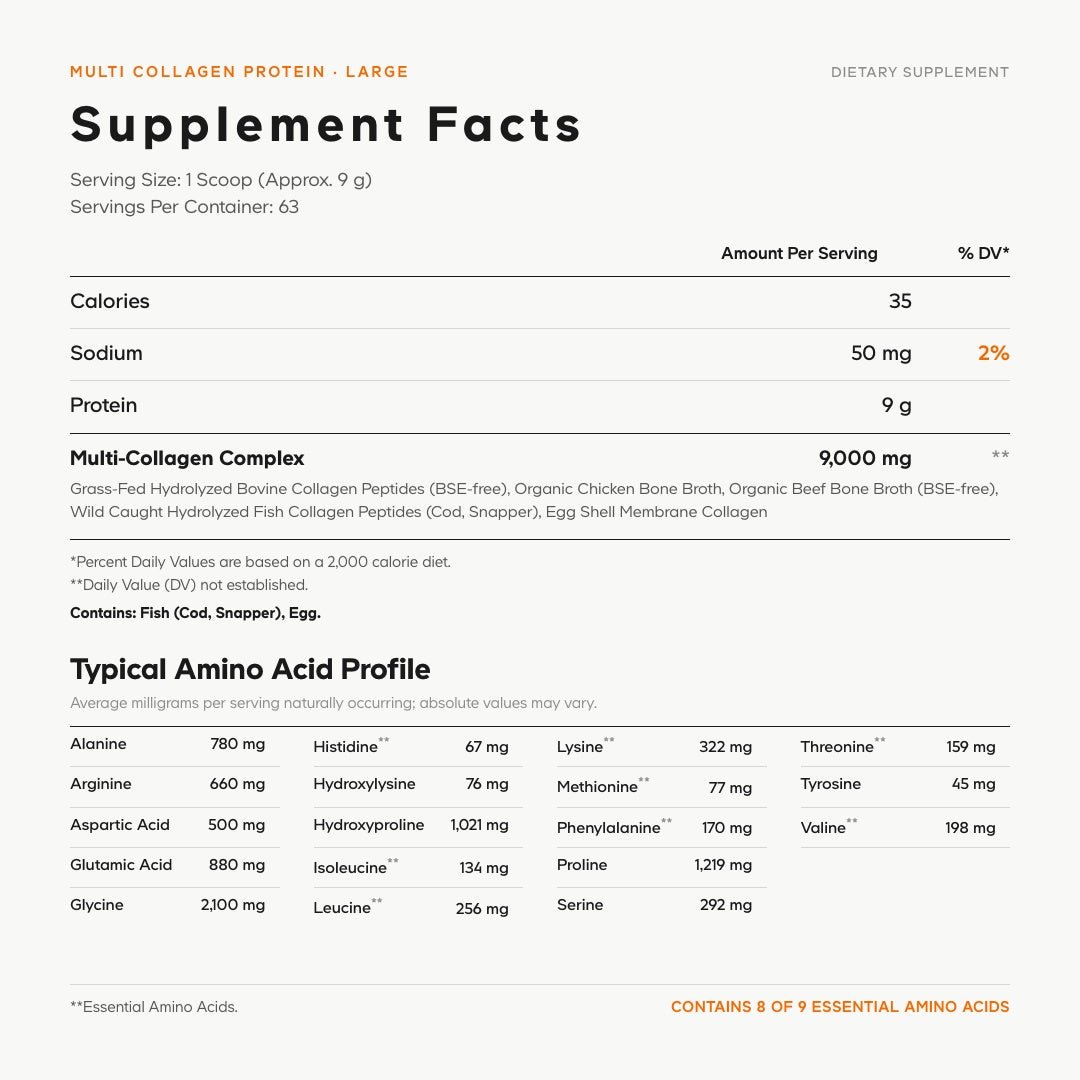
The Codeage label is an example, not a universal multi-collagen formula. Ancient Nutrition Multi Collagen Protein currently advertises ten types and adds vitamin C and a probiotic to a multi-source complex. Compare its exact variant and serving panel rather than assuming all multi-collagen tubs share one recipe. Our Ancient Nutrition versus Codeage comparison examines those two products separately.
If the individual type or source amounts are not disclosed, you can compare the listed total blend, protein, serving size, ingredients, allergens, and price, but cannot calculate a reliable price per gram of a particular type. A “five types” claim alone is not clinical evidence.
A practical label checklist
- Match the exact variant and serving. A flavored version or different size can have another panel. Note grams or milligrams per labeled serving.
- Find the source and form. Look for bovine, fish, chicken, or egg ingredients and for “hydrolyzed” or “undenatured.” Do not infer one from the type number alone.
- Separate totals. Collagen grams, protein grams, and a multi-ingredient complex amount may be different numbers. Check whether a per-type breakdown exists.
- Read the allergen and added-ingredient lines. Multi-source formulas may combine fish and egg; some formulas also include vitamins, probiotics, flavors, or sweeteners.
- Check testing claims by scope. A facility certificate, a finished-product certification, and a batch-specific test answer different questions. A logo is not proof of a clinical outcome.
- Compare cost on the same basis. Cost per labeled serving works only when the servings are comparable. For unlike forms, compare the exact preparation and evidence before comparing price.
Some products include biotin. The FDA warns that biotin can interfere with certain laboratory tests; tell your healthcare team about supplements you take before testing. This is one reason to read added ingredients rather than looking only at the collagen type list.
For a broader product shortlist, see our best collagen supplements guide. Use the checklist on the current package even when a review includes a label image, because formulas and packaging can change.
Frequently asked questions
Is more collagen types always better?
No such conclusion follows from the count. It tells you which types the brand claims are present, but may not disclose an amount for each or establish a better outcome in a comparison trial.
Is hydrolyzed type II the same as undenatured type II?
No. Both can originate from cartilage, but processing and the final ingredient differ. A study on one preparation cannot automatically support claims for the other.
Does marine collagen go only to skin?
No. “Marine” names an aquatic source, commonly fish, while type I names a collagen classification. Neither term specifies where an oral product will have an effect in the body.
Are plant-based “collagen builders” collagen?
Usually they are blends of nutrients rather than animal-derived collagen peptides. Ingredient technology is evolving, so check the actual protein source and amount on any product making a plant-based or fermentation-derived collagen claim. Do not assume a nutrient blend has been studied like an oral collagen peptide.
What about vitamin C?
Vitamin C is required for normal collagen biosynthesis, but a label with added vitamin C does not establish a better skin or joint result. Our vitamin C guide explains the distinction.
Bottom line
Read a collagen label in this order: form, source, amount, then type. Type I, II, and III are useful descriptors, but they are not a ranking of products. A precise ingredient panel and evidence for the exact preparation are more informative than a long type list or an unqualified promise.